Explore glass substrates and silica, critical materials revolutionizing future computing. Discover how these innovative materials enable faster, more efficient high-performance semiconductors in the age of AI.

The Mounting Demands: Why Current Tech is Hitting a Wall
As artificial intelligence continues its rapid ascent, nearly every digital device around us demands unprecedented levels of power and efficiency. From the smartphone in your pocket to massive data centers and self-driving vehicles, the sheer volume of data needing processing is exploding. However, the semiconductor substrate materials predominantly used today are increasingly struggling to keep up with this insatiable demand. Issues like increased power consumption and heat generation—which intensify with higher integration and miniaturization—are becoming major bottlenecks for performance improvements. It's like trying to funnel an ever-growing river through a narrow, old pipe; eventually, it just can't handle the flow. To overcome these technical hurdles and build the computing environments of tomorrow, we desperately need innovative materials and approaches that go beyond the status quo. This is precisely where a new foundation for semiconductor technology is beginning to capture significant attention.
The Revolutionary Potential of Glass: Inside Next-Gen Semiconductor Foundations
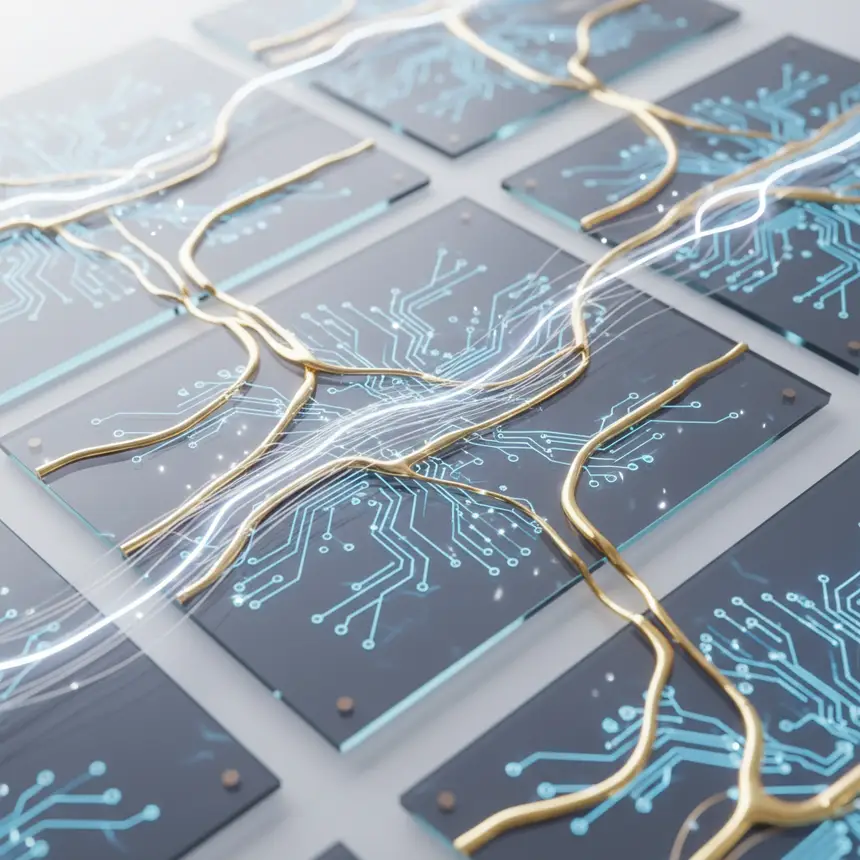
One of the most promising answers to these technological challenges is the 'glass substrate.' Surpassing the density and performance limitations of traditional plastic-based substrates, glass substrates hold the potential to boost data processing capacity by up to 8 times while simultaneously cutting power consumption by half. Industry experts anticipate that mass production could become a reality between 2026 and 2027, sparking intense technological competition.
Another key application where glass plays a vital role is 'optical fibers.' While both utilize glass, their functions are distinctly different. A glass substrate is a flat, thin panel designed to mount semiconductor chips directly and connect electrical signals, forming a data pathway between the chip and the circuit board. In contrast, an optical fiber is a slender thread designed for long-distance transmission of light signals, utilizing the principle of total internal reflection to carry information across data centers and communication networks.
The common denominator and core material for both these innovative technologies is 'silica' (silicon dioxide, SiO₂). It's the main component, making up 70-75% of ordinary glass. For semiconductor applications, ultra-high-purity silica, over 99.7% pure, is absolutely essential. Achieving this level of purity requires sophisticated separation and chemical treatment processes to eliminate impurities. Driven by the explosive demand from the AI and semiconductor industries, the high-purity silica market is projected to grow from $124.1 billion in 2024 to $186.2 billion by 2030, with the high-purity segment alone showing a steep annual growth rate of 15.4%.
Another key application where glass plays a vital role is 'optical fibers.' While both utilize glass, their functions are distinctly different. A glass substrate is a flat, thin panel designed to mount semiconductor chips directly and connect electrical signals, forming a data pathway between the chip and the circuit board. In contrast, an optical fiber is a slender thread designed for long-distance transmission of light signals, utilizing the principle of total internal reflection to carry information across data centers and communication networks.
The common denominator and core material for both these innovative technologies is 'silica' (silicon dioxide, SiO₂). It's the main component, making up 70-75% of ordinary glass. For semiconductor applications, ultra-high-purity silica, over 99.7% pure, is absolutely essential. Achieving this level of purity requires sophisticated separation and chemical treatment processes to eliminate impurities. Driven by the explosive demand from the AI and semiconductor industries, the high-purity silica market is projected to grow from $124.1 billion in 2024 to $186.2 billion by 2030, with the high-purity segment alone showing a steep annual growth rate of 15.4%.
※ This post contains affiliate links. I may earn a commission at no extra cost to you.


Glass Substrates and Silica: Paving the Way for Tomorrow's Technology
Glass substrates and high-purity silica are more than just novel materials; they are fundamental drivers poised to reshape the future computing paradigm. As this technology matures and becomes widespread, we can expect significant improvements in current limitations regarding data processing speed, power efficiency, and device miniaturization. Imagine AI training speeds accelerating dramatically, or the battery life of your portable devices extending significantly—these are the tangible changes on the horizon. Such technological advancements won't just improve performance; they'll form the bedrock for accelerating progress in cutting-edge industries like autonomous driving, virtual and augmented reality (VR/AR), and the Internet of Things (IoT). It's fascinating to ponder how the electronic devices we use daily will evolve. Understanding the importance of these foundational materials, which drive innovation from behind the scenes, is a crucial key to deciphering future technological trends. It’s worth keeping a close eye on how glass substrates and high-purity silica will contribute to building the high-performance infrastructure required for the upcoming AI era.
Frequently Asked Questions
Q. How do glass substrates differ from current semiconductor substrates?
A. Glass substrates can boost data processing speeds by up to 8 times and reduce power consumption by half compared to traditional plastic-based substrates. They also facilitate higher integration and miniaturization, enabling the creation of smaller, more powerful semiconductors.
Q. Why is silica used in both glass substrates and optical fibers?
A. Silica is the primary component of glass, offering excellent transparency, strength, and high heat resistance. These properties are critical for both high-performance semiconductor substrates and long-distance data transmission through optical fibers.
Q. Why is high-purity silica so crucial?
A. In semiconductor and optical technologies, even tiny impurities can degrade performance. Ultra-high-purity silica (over 99.7%) is essential to prevent these issues, maximizing data transmission efficiency and device stability.
Q. When is glass substrate technology expected to be commercially available?
A. Industry experts anticipate that mass production and commercialization of glass substrates will begin between 2026 and 2027. Active technological development and prototype validation are currently underway.
Q. What role does silica play in modern technology?
A. Beyond glass substrates and optical fibers, silica is a key material in various advanced industries, including smartphone displays, solar cells, and insulators. High-purity silica, in particular, is indispensable throughout the semiconductor manufacturing process.